Climate Change is (still) Class War
Clarifying arguments in a controversial NYT Essay
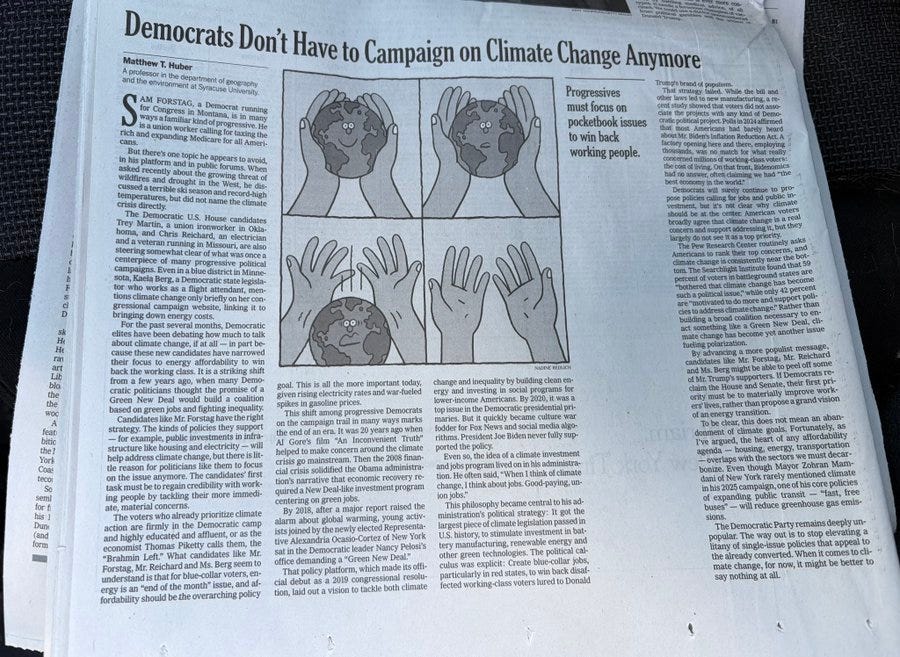
As someone who writes a lot, I can’t deny it’s exciting to publish something in the “paper of record”: The New York Times. But, this particular opinion essay — arguing that the Democratic Party should not campaign on the climate crisis anymore — has ignited a fierce backlash (along with some appreciation!)
One bit of debate focused on whether or not the essay was a departure from the arguments laid out in my 2022 book Climate Change as Class War: Building Socialism on Warming Planet. I posted (and maintain) that the core thesis of the book and the essay are the same: we can not meet the scale of climate change without broad-based political power rooted in popular, majoritarian working-class politics.
I was then yelled at by Nathan Robinson of Current Affairs that this is not true: while the book was “superb” (thanks Nathan!) the essay was, “one of the biggest piles of shit I’ve ever seen in the NYT (and I read it every day so I’ve seen some truly steaming manure)” (yikes!). Nathan astutely found a passage that argued for linking a Green New Deal to a rising climate consciousness. It’s true I’ve become less convinced of this idea, but it still does not contradict the core thesis.
The book tries to argue that solving climate change is a question of power (and for such a large-scale challenge as this, one of class power). The path to power is a traditional Marxist one: working-class power.
But the working class is rapidly shifting politically, and since the book came out I’ve become less optimistic that a rhetorical focus on the “climate crisis” should be the central impetus of the political project to build that power. The most important problem that should concern any Leftist or socialist is the problem of “class dealignment” —that is, former working-class parties shifting their base toward more affluent-educated voters, while working-class voters shift rightward. This problem has only gotten worse. In 2024, for the first time in decades, Trump won voters making less than $50,000/year (in 2012 Obama won that segment by 28 points). Trump also won voters without a college degree by a whopping 14 points in 2024 (a margin that just keeps going up: he won this group by 8 points in 2020, and 7 in 2016).1
Mind you, one could argue that this process of class dealignment has intensified during the very period where climate change was a top issue in Democratic Party debates (2020) and policy (the Biden Administration 2021-2025). In other words, class dealignment continued during the era of the Green New Deal (~2018-2024). To make matters worse, we went through a cycle of political struggle over this climate-centered political idea and, on climate grounds, very little to show for it (US emissions rose in 2025!), besides the charred remains of the Inflation Reduction Act (to be clear, there are parts of the IRA that still exist and are good!).
At least according to one set of polls, climate is also clearly an issue reinforced by class dealignment. David Shor’s Blue Rose research made a presentation in 2024 that not only showed that climate and environment rank low in voters concerns in general, but also that climate is a top issue only for “rich Democrats” making over $150,000/year. Poor democrats do not rank it highly at all. As I put it in the piece, “The voters who already prioritize climate action are firmly in the Democratic camp and highly educated and affluent, or as the economist Thomas Piketty calls them, the ‘Brahmin left.’”
So what happened? The core argument underlying the New York Times essay is that the Green New Deal —and climate more broadly—has become a poisoned and polarized issue. But it didn’t have to be this way. When the Green New Deal exploded on the scene in 2018 when AOC sat in with the Sunrise Movement in Nancy Pelosi’s office, it had the potential to evolve into as kind of mass, working-class program focused on jobs, public goods and the decommodification of core material needs like health care, housing and even (ambitiously) electricity.
As I’ve written before, that initial sit in the activists parroted Bernie Sanders-style universalist messaging “green jobs for all” (despite that not really being possible) and many suggested the Green New Deal could become the climate “Medicare for All” for the Democrats.
But, almost immediately, the policy was hijacked by the professional class base of the Democratic Party residing in academic, environmental NGOs, and DC think tanks. As I argued way back in 2019, professional class climate politics does not want to make climate change about broadly felt working-class benefits, but rather about “marginalized communities” that are “disproportionately burdened” by the toxic byproducts of fossil capitalism. The more liberal climate advocates are also obviously highly educated and obsessed with climate change as an issue of belief or denial of the “science” or one that is technocratically focuses on emission targets, carbon budgets, and other benchmarks.
The film To the End (see my review here) documents the Sunrise Movement’s struggle over the Green New Deal up until the passage of the Inflation Reduction Act. Strikingly, soon after the infamous sit in at Pelosi’s office, the activists find themselves at an organizing conference in a fancy hotel ballroom with many other left/progressive NGOs (we now call them “The Groups”.) Strikingly, to me anyway, was how the conference seemed to devolve into what is oh-so-typical of Left organizing spaces: lots of accusations about ‘silencing’ voices, privilege, and the like. We were already far, far away from building a mass working-class program of universal benefits.
Then, AOC came into office and very quickly introduced the “Green New Deal” resolution to Congress. She did a media blitz in association with the proposal and, for reasons I’ll never understand, her office released a truly unhinged FAQ document that spoke of a long-term goal to “fully get rid of farting cows and airplanes.” The document also disavowed nuclear power and carbon capture (standard fare for environmental NGOs, but deeply offensive to unions).
To add insult to injury, it seems clear AOC nor anyone else in the movement actually worked with the affected labor unions to get their ideas on the Green New Deal resolution. As such, the AFL-CIO came out against the policy (another central argument of my book is that unions represent a critical institution of organized power that must be harnessed to fight the climate crisis).
The issue of the Green New Deal was quickly churned through the Fox News culture war grinder, and politicians were equating the Green New Deal with efforts to take away Americans’ hamburgers.
To be fair, the Sunrise movement and others did organize sufficient pressure to genuinely influence the Biden Administration’s platform and eventual prioritization of climate with the Inflation Reduction Act. But, interestingly, once Biden had won I distinctly remember some of the most prominent ideological supporters of the Green New Deal emphasize that the most important policy goal in influencing the Biden Administration was no longer “Green Jobs for All” — or any kind of universalist working-class program — but something called the “Justice 40”: the idea that 40 percent of climate investments must go to means-tested “disadvantaged communities.” The Biden Administration listened. They set up something called the “environmental justice screening tool” and much of the money appropriated went directly not to working-class people, but NGOs who claim (often falsely) to represent these marginalized communities.
In short, I really do think the Green New Deal could have been a mass, working-class program that helped build the majoritarian coalition I argue for in my book, but unfortunately it degenerated pretty quickly into an NGO-led cocktail of insane technological ideas combined with moralistic dictums of “centering the marginalized.”
And all the while, as Ruy Teixeira pointed out consistently (RIP The Liberal Patriot — an indispensable chronicler of class dealignment that apparently was killed by the climate movement), the working-class continued to shift away from the progressive Democratic Party’s ideas on climate and much else. So my NYT piece was an attempt to grapple with this history and admit the climate issue in general and the Green New Deal in particular might just be….cooked. It has just become too politically polarized to be the vehicle for working-class power. But working-class power is what we need to solve the climate crisis. On that point, nothing has changed.
And, with examples like Zohran Mamdani, I’ve become convinced the path to working-class power is a “socialist minimalism” as Benjamin Y. Fong put it; a “laser focus” on working-class material concerns of immediate day-to-day survival. That agenda would be much broader than the climate crisis. It would be an anti-austerity public goods agenda that could absolutely include climate investments in electricity, transport, housing and more, but that would also concern much else that concerns the working-class — health and child care, affordable education, etc.
In the end, solving climate change will require broad-based power — as Kate Aronoff put it, “durable, hegemonic majorities.” It might be time to admit that the climate crisis itself may not be the vehicle to build it.
Another stunning statistic: in 2020, Biden won Hispanic voters without a college degree by 19 points (58 to 39), but in 2024 Trump won this group by 1 point (50 to 49). And, yes, I realize income nor education is equated with “the working class” in Marxist terms, but these demographics are disproportionately working-class and useful proxies.