Who is in the Working-Class?
An age-old question is back


I’m in Jacobin this week analyzing the climate implications of a new report from Joan C. Williams and Jared Abbott, “The Left’s Coalition Crisis” that shows the rising ideological gap between the liberal, educated base of the Democratic Party, and the wider working-class voters who the Democrats are (sometimes happily) hemorrhaging.
The methodology was pretty clear, as I described in Jacobin:
The report is specifically interested in comparing the class gap between upper-middle-class liberals — people with college degrees who vote or lean Democratic and who have household incomes in the top 25 percent of the distribution — and a specific portion of the US working class defined as “the group that has veered far right . . . middle-status voters.” This group is specified as non-college-graduate households in the middle 50 percent of the income distribution, making between roughly $40,000 and $100,000 per year.
The overwhelming reaction (on social media at least) was anger that Williams and Abbott compared one sample that was ideologically liberal (“Dem Leaning” as described in the report) while the working-class sample was not. But this was by design — the goal of the report was to compare the base of the Democratic Party with the specific portion of the working-class we know is susceptible to shifting to the the populist right.
It should be obvious why this comparison is important. It is not only that the Democratic Party has historically been the party of the working-class — so the views of those in the middle income distribution and lacking college degrees should be of interest — but also if the Democrats do not win over such workers, their capacity to build durable majorities will never come to pass. And, without durable majorities the current doom loop of partisan vacillation and political gridlock is assured. As Matt Karp memorably put it years ago, we will continue to be 51% losers.
But, many other complaints questioned the report’s definition of the working-class specifically (ignoring the report’s own rationale for only looking at part of the working-class). As a Marxist interested in reviving working-class politics, it has been frankly astonishing to see this question — who is the working class? — skyrocket to the top of media punditry with many prominent outlets giving their own take on the matter.
Most of this discussion is because in a highly circulated New York Times interview with democratic socialist Mayor of NYC Zohran Mamdani was asked how he defines the working class (the same interviewer, Lulu Garcia-Navarro asked the ill-fated Graham Platner the same question back in May). Mamdani’s answer caused a lot of controversy for its expansiveness:
I think if you have to work to pay your bills, I think that that is one definition of being a part of the working class.
It’s cool to be able to say this out loud, but the socialist, cadre Mayor Mamdani is using a basic Marxist definition of the working-class: those who are forced to sell their labor power in exchange for a wage or salary to survive. This is what I’d call the ownership definition. In our society, some own capital (businesses, productive resources), wealth (like a trust fund yielding returns) or property (rent) that they can live off, but the vast majority of us only own one thing that can allow us to live — labor power — and we must sell it day-by-day and work for a living. We usually sell it to capitalists, but can also sell it to government or nonprofits.
It is important to point out that this definition is not occupational, but relational: a carpenter who owns their own contracting business is not working-class, but one who works for a contracting corporation is (the relation is employer and employee in this case).
So who is the working-class from this perspective? Recently, Dylan Riley and Robert Brenner provided an elegant answer in the New Left Review with the following two tables:
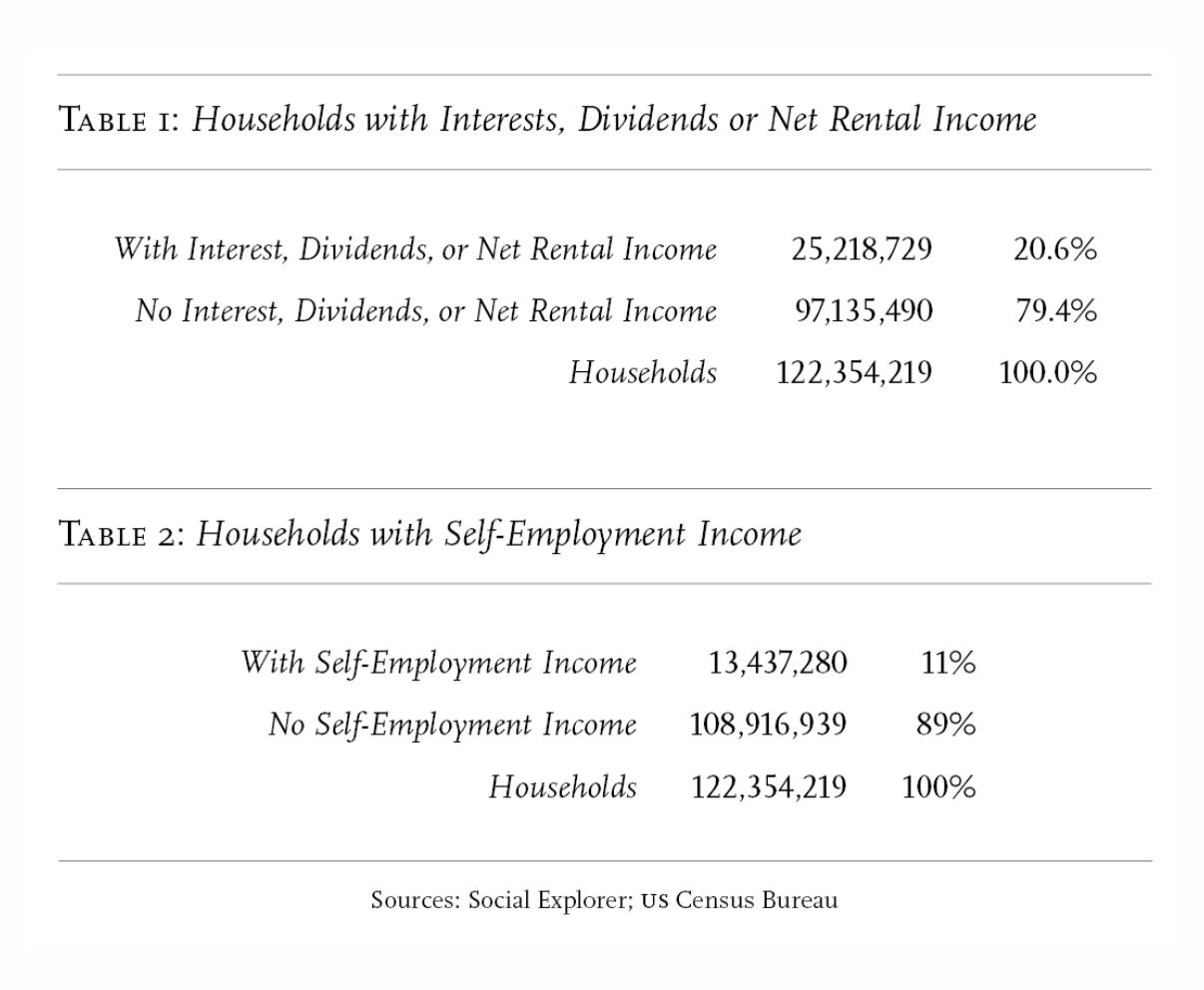
As they explain,
Putting these two pieces of evidence together, we can establish a lower bound for the quantitative extent of the working class. Even assuming that all households with self-employment income are owners of their main means of production and do not rely on wages, 68 per cent of the us population would be in the working class. Accordingly, at this level of generality, Marx’s claim that the nineteenth-century working class constituted the ‘vast majority’ of capitalist society remains correct.
But, for Marxists, this is not the whole story. Class is defined not only by what you own, but also your power (the “power definition”). Obviously, capitalists are defined by their control of the “means of production” and thus possess a dictatorial level of power over the workers they hire in the workplace. But, some of those who sell their labor for wages also have significant amounts of power over others in the workplace (there’s a great overview of all of this on the Confronting Capitalism podcast with Vivek Chibber).
Managers are the classic example: they might be paid a wage, and they might even be quite precarious (imagine you are a manager at a Dollar General), but because they have power over other wage workers (and, in fact, contribute to their exploitation) they can’t be considered working-class. The extreme example would be a hired CEO who manages a corporation (but let’s imagine the CEO is given zero ownership stakes in the company itself).
However, power is not only power over others, but also autonomy over your own work life and decisions. Here the classic example is a tenured professor (ahem) who has significant autonomy over what they research and teach (mind you this is increasingly an extinct species as increasing proportions of faculty lack tenure, and even the tenured among us are subjected to more-and-more top-down, “corporatized” governance structures that try to dictate what we can teach, research or even say on social media ).
Other so-called “creative class” occupations in film, art, media and even marketing might have significant degrees of autonomy over their work. Yet, for most of them (including me), they are forced to work most days to earn their living. So it’s fair to include them in the broader working-class even if some might want to equivocate that they are part of the “professional class”, “PMC” or “middle class.”
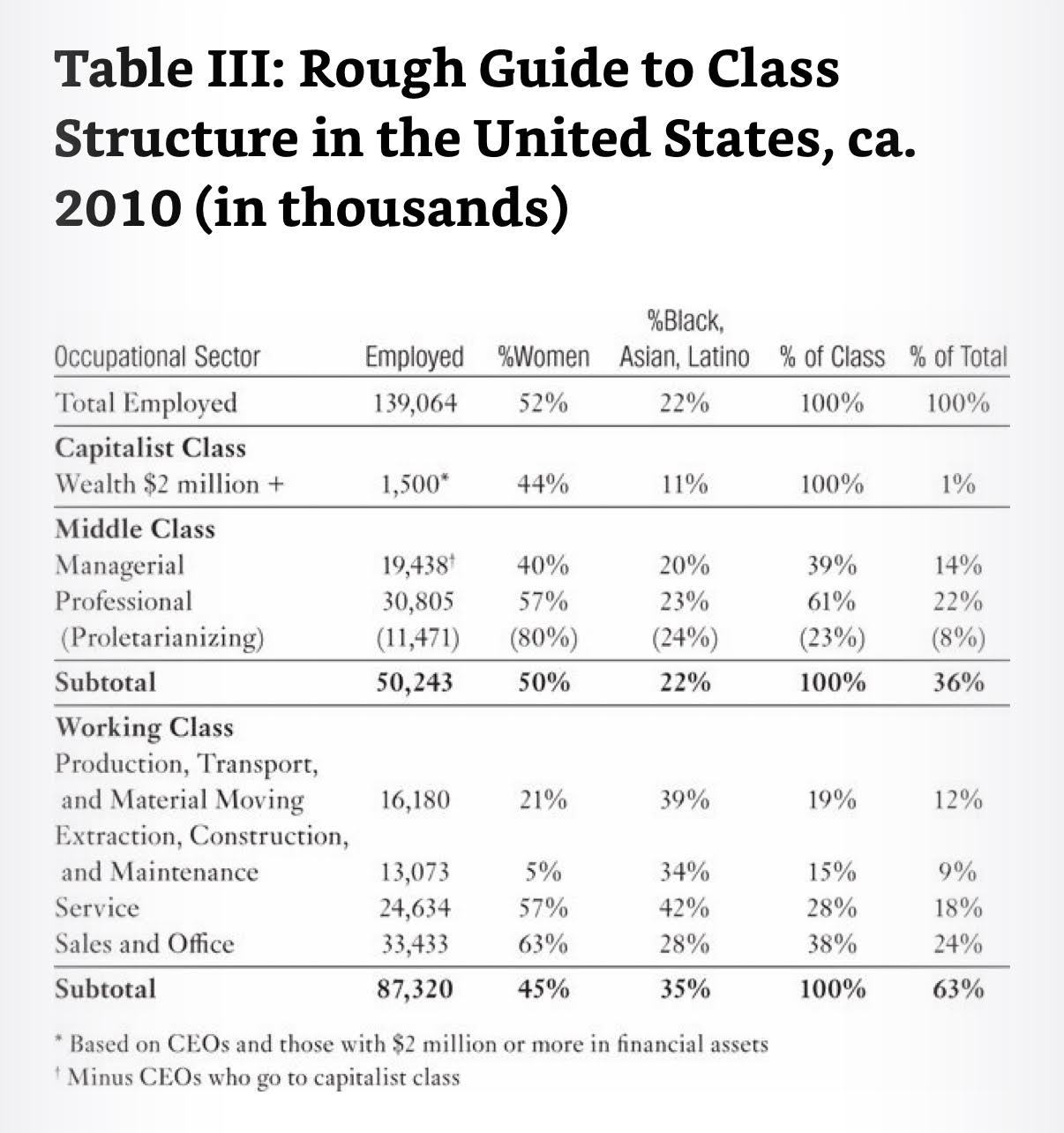
There have been efforts to define the extent of the working class that takes power/autonomy into account. In his book, On New Terrain (2017) Kim Moody — drawing on the Michael Zweig and his indispensable book, The Working Class Majority (2011)— uses census data to code occupations in terms of power/automny and comes up with the following table (outdated as it is from 2010). Even if we take out the professionals and managers (even the “proletarianizing” portions of the professional class like K-12 teachers and nurses), we again are left with the vast majority of the workforce —63%. Moody also points out we must include those working but not for wages in the household or in other unpaid care capacities (He estimates this should take the estimate up to 75%).
So, what does this all mean when we go back to the report from Williams and Abbott? First, it is clear from a technically Marxist point of view, some of the “liberal elite college grads” sampled — even with their position in the top 25 percent of the income distribution — are in the “working class” (a point that Marxist academics who fit this description never tire of pointing out). Second, there are most likely a small percentage of people in the “working class” sample who are managers or small-business owners, and thus not technically part of the “working class.”
But, their sample of non-college educated, middle income was never meant to define the working-class, but rather act as a proxy for the bulk of the working-class, and, more specifically, the specific portion that has been known to be shifting right toward Trump. While Marxists get very angry about measuring “working class” by education-levels, it is plainly the case that education has been a major driver of political polarization (many call this “educational polarization” but it also maps onto what Abbott and others call “class dealignment”). In other words, this way of looking at the class gap between affluent educated voters and the wider working-class is extremely important for our political conjuncture (even if it doesn’t cleanly map onto a Marxist definition of the working-class).
On the other hand, even if we do include many professionals and other middle class people in the “working class,” it is also the case that these people, by and large, already are disproportionately liberal or progressive or even socialist. We should not worry about losing them to our left-wing political project. But we are losing those without college degrees (and I’d add blue collar workers in particular).
In sum, Marxist politics is the attempt to build a politics capable of uniting the whole working class into a majoritarian, mass force. So it is extremely important to study and understand the views and attitudes of the parts of the working class shifting right. That is precisely what Williams and Abbott’s report sets out to do — and its extremely valuable for that reason.